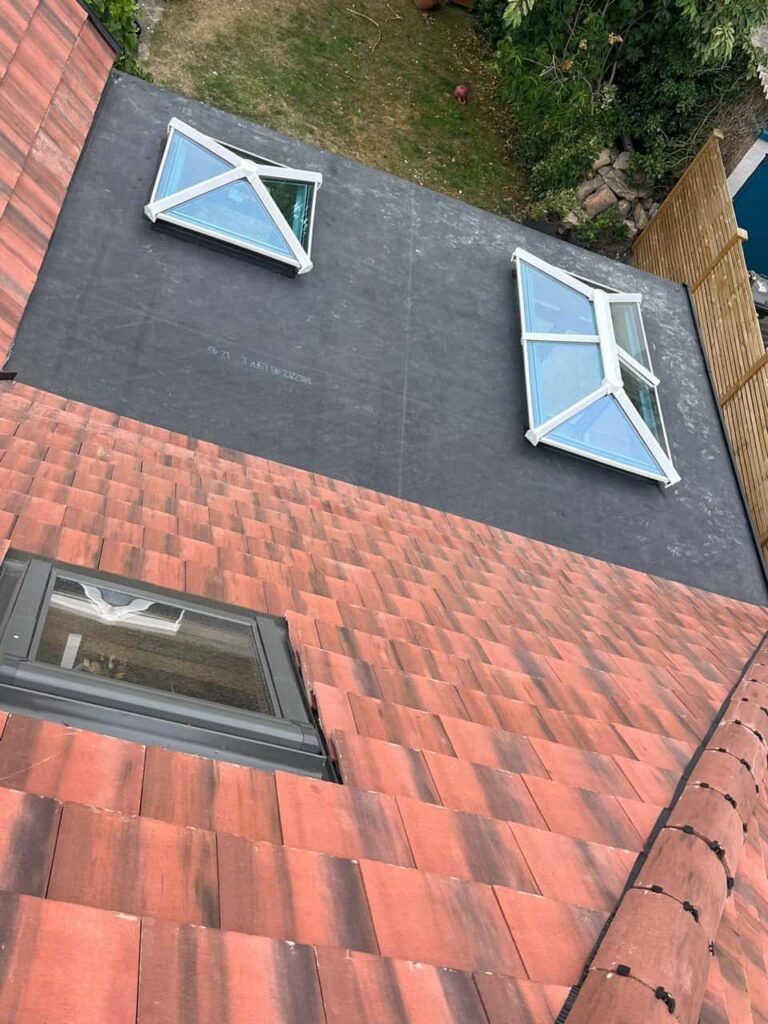
The deciding factor is not simply how noticeable the damage appears. A professional assessment must establish its cause, depth and extent before the appropriate repair area can be defined. For property owners in Market Harborough, Leicestershire, this approach helps preserve serviceable roofing materials while ensuring that concealed deterioration is not left untreated.
When Is a Localised Roof Repair Likely to Be Successful?
A focused repair is most suitable when the defect can be clearly identified, the damage is confined to a limited area and the surrounding roofing system remains dependable. The repair must address every affected layer rather than covering only the visible symptom.
The Damage Is Limited to Individual Tiles or Slates
One or several cracked, slipped or missing tiles can often be replaced without disturbing a large section of the roof. The neighbouring materials should remain correctly aligned, securely fixed and free from widespread deterioration.
The battens, underlay and fixings beneath the affected area also need checking. Replacing the visible tile alone may not provide a lasting result if its support has weakened.
A Flashing Defect Has a Clear Cause
Lead flashing around chimneys, walls and other roof junctions can sometimes split, lift or work loose while the surrounding roof remains sound. Where the defect is localised, the affected flashing may be repaired or renewed without replacing a substantial area of tiles.
The adjoining mortar, masonry and roofing materials should be examined as part of the same repair. This confirms that water is not entering through a second nearby weakness.
Only a Small Area of Underlay Is Damaged
Damaged underlay does not always require the complete roof covering to be removed. Tiles or slates can sometimes be lifted across a controlled area so the underlay and battens beneath can be inspected and repaired.
The repair area may need to extend beyond the visible opening to allow the new material to overlap securely with sound underlay. This is still a localised repair, but it must be large enough to create an effective weather-resistant detail.
The Leak Has Been Traced Accurately
Water can travel along underlay, rafters and other surfaces before appearing inside the property. The damp patch on a ceiling may therefore be some distance from the actual entry point.
Professional leak detection helps prevent work being completed in the wrong location. Once the source and route of the water have been established, a focused repair may be sufficient even when the internal staining appears extensive.
A Flat Roof Has an Isolated Defect
A small split, open seam or failed edge detail on a flat roof may be repairable when the surrounding covering remains firmly bonded and in good condition.
The area should be checked for trapped moisture, blistering and deterioration beneath the surface. Applying material over a wet or unstable base is unlikely to provide a dependable result.
The Supporting Structure Remains Sound
Localised repairs depend on the roof’s underlying components remaining serviceable. Battens, decking and structural timbers must be capable of supporting the repaired covering.
If these elements are dry, secure and free from significant deterioration, there may be no reason to replace sound materials elsewhere. Where hidden damage is found, however, the repair area should be widened sufficiently to reach a stable section.
Why the Repair Must Address the Root Cause
A successful repair resolves why the defect developed. Tiles may slip because of failed fixings, flashing may separate because of movement, and repeated leaks may result from a damaged junction rather than the nearest visible tile.
Treating only the surface symptom can allow the problem to return. A complete local repair may include several connected tasks, such as replacing damaged battens, renewing underlay and refitting the outer covering.
When Is a Larger Repair Area Necessary?
Removing a wider section may be appropriate when deterioration extends beyond the visible fault. Warning signs include:
- several leaks affecting different areas;
- widespread loose, cracked or porous tiles;
- extensive underlay deterioration;
- weakened battens across a roof slope;
- damp or damaged roof decking;
- numerous failing previous repairs; and
- recurring faults after earlier localised work.
A larger repair does not automatically mean that the entire roof needs replacing. Sectional work may still be possible if the remaining slopes and components are performing correctly.
Does an Older Roof Always Need Extensive Work?
Age alone does not determine whether a roof can be repaired locally. An older roof may still have sound coverings and supporting materials, while a newer roof can develop an isolated installation defect.
The decision should be based on present condition, not an assumed lifespan. An inspection can distinguish normal ageing from deterioration that prevents new materials from integrating reliably with the existing roof.
The Importance of Matching Existing Materials
A targeted repair should integrate with the roof both functionally and visually. Replacement tiles or slates must be suitable for the existing covering, pitch and fixing method.
Accurate matching also helps maintain consistent overlaps and drainage. Forcing an unsuitable material into position can create gaps, uneven loading or further movement.
Avoiding Unnecessary Disturbance
Removing sound roofing materials without a clear reason can increase the amount of work and disturb areas that are currently performing properly. A measured repair keeps intervention focused on the components that genuinely require attention.
However, limiting the repair too aggressively can be equally unhelpful. The area must be large enough to remove all damaged material and connect the repair securely to a sound part of the roof.
What a Professional Assessment Should Establish
Before recommending a localised or sectional repair, a roofer should determine:
- where water or weather exposure is entering;
- how far the defect extends beneath the covering;
- whether surrounding fixings and materials remain secure;
- whether previous repairs are performing correctly;
- whether the support beneath the roof is sound; and
- whether the proposed repair can integrate reliably with the existing materials.
These findings provide a practical basis for deciding how much of the roof needs to be disturbed.
Conclusion
A roof can often be repaired successfully without replacing large sections when the defect is accurately diagnosed, confined to a manageable area and surrounded by sound materials. Targeted repairs can resolve damaged tiles, flashing, underlay and flat-roof defects while leaving dependable parts of the roof undisturbed.
If you have noticed a roofing problem at your property in Market Harborough, Leicestershire, Market Harborough Roofing Repairs can assess the full extent of the damage and determine whether a localised repair is suitable. Contact us to arrange a professional inspection and receive clear guidance based on the roof’s actual condition.
Call us on: 01858 457 198
Click here to find out more about Market Harborough Roofing Repairs
Click here to complete our contact form and see how we can help with your roofing needs.